
The problem with planning maths lessons one at a time


You cannot plan a maths sequence lesson by lesson. Not well anyway. Not in a way that reliably results in learning. The reason is not about effort or expertise. It is about prior knowledge.
A child learns something new only by connecting it to what they already know. In the first years of school a child can take in only a tiny amount of new knowledge at a time, so each lesson can carry only a small new piece. For that piece to stick, it must fit closely onto what came before. It must fit the content of the earlier lessons, and the way those lessons were taught, the representations used and the order they came in. Get the fit right and the new knowledge sticks. Get it slightly wrong and it does not, and you often cannot see why until a child isn’t getting it.
This is why a sequence cannot be planned week by week or day by day. The fit must be built across the whole thing, in order, in advance. And yet teachers are expected to do all of this while managing all other classroom demands. Understanding the learning sequence, planning the lessons, teaching them well, identifying who is falling behind and why, differentiating for the children who need something different. That is an enormous amount to hold at once. It is not surprising that planning happens week by week. It is the only thing that feels manageable. But it is also why so many children arrive at Year 3 with gaps nobody quite saw coming.
Here is what this looks like in practice...
Take this question from one of my lessons. A bar model, a whole of fourteen shown as dots, one part of nine shown as circles, and an empty space where the missing part goes.
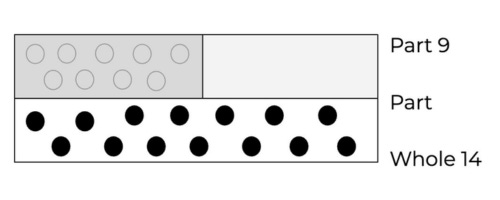
The prior knowledge I made sure was in place for this lesson was this:
• the bar model was already familiar
• the two parts and the whole had been met in stories, then dots, then tens frames, then numerals
• combining parts and partitioning wholes had each been worked through twice, first to ten and then to twenty
• finding a missing part had been practiced many times with smaller numbers
• the child already understood that a numeral and a collection can name the same amount
• and the child was familiar with part and whole questions that look like this one and work the same way
The one new thing in this lesson is finding the missing part in this kind of question. That is it. Everything else was already there.
If the best learning results from getting the specific elements in a lesson fine-tuned to the level of detail in this example, then we cannot do this unless all the connected lesson details are already determined.
A piece that fits one good sequence can fail in another good sequence, because the children got there a different way. So you cannot borrow a piece from elsewhere, even a very good one. Once you choose a sequence you are bound to it.
The slow, specific work of building that sequence is real and it is also exactly the kind of work that gets crowded out when a teacher is stretched across everything else a classroom demands. But it only needs to be done once. When it is already done, the planning, the resourcing, the guesswork is finished. What is left is the teaching. That is what I have spent years working toward. If you are curious about what that looks like in practice, take a look at The Y Intercept.
Until next time, Bridget